

If you’re a Ram truck owner or mechanic dealing with heavy-duty diesels, you’ve likely asked yourself: how much oil does a 6.7 Cummins take? This powerhouse engine, found in Ram 2500, 3500, and beyond, is a staple in agriculture, construction, and towing applications thanks to its legendary durability and torque. But getting the oil capacity wrong can shorten engine life by up to 20% due to poor lubrication or overheating—issues that cost thousands in repairs. In this guide, we’ll focus on comparing the 2012 and 2018 models, providing precise data, expert tips, and real-world insights to help you maintain peak performance.
Whether you’re a first-time DIYer in Virginia facing cold winters or a fleet operator hauling loads, understanding how much oil does a 6.7 Cummins take ensures longevity (up to 500,000+ miles with proper care). We’ll cover history, exact capacities, comparisons, recommendations, and common pitfalls.
6.7 Cummins Engine History & Applications
Development History
The Cummins 6.7L turbo diesel debuted in 2007 as a replacement for the 5.9L, designed to meet stricter emissions while boosting torque and efficiency. By 2012, it had matured into a reliable workhorse with around 800 lb-ft of torque, complying with EPA Tier 2/3 standards through basic EGR and no full DPF/SCR emissions system yet. The 2018 model marked further evolution, incorporating upgraded Tier 4 Final emissions tech like enhanced SCR and DPF systems, pushing torque to 930 lb-ft in standard output (up to 1,000 lb-ft in high-output variants), without altering core structures like the oil pan. These iterations set the stage for our capacity comparison—emissions upgrades didn’t change oil volume, but they influenced oil specs for better protection.
Core Application Areas
Beyond its evolution, the 6.7 Cummins’ versatility has made it a cornerstone in multiple heavy-duty industries—let’s explore its core applications and how they tie to oil capacity. The 6.7 Cummins powers heavy-duty pickups like Ram 2500/3500, chassis cabs (4500/5500), and equipment in construction (e.g., excavators), agriculture (tractors, sprayers), and mining (dump trucks). In these scenarios, oil capacity directly impacts heat dissipation during long hauls or heavy loads—underfilling in a mining rig could lead to bearing failure, while proper levels ensure smooth operation in cold Virginia winters.
How Much Oil Does a 6.7 Cummins Take?
Now that we’ve covered the engine’s background and applications, let’s dive into the core of our research: precise oil capacity data for the 2012 and 2018 6.7 Cummins, along with key details to avoid common mistakes.
2012 6.7 Cummins Oil Capacity
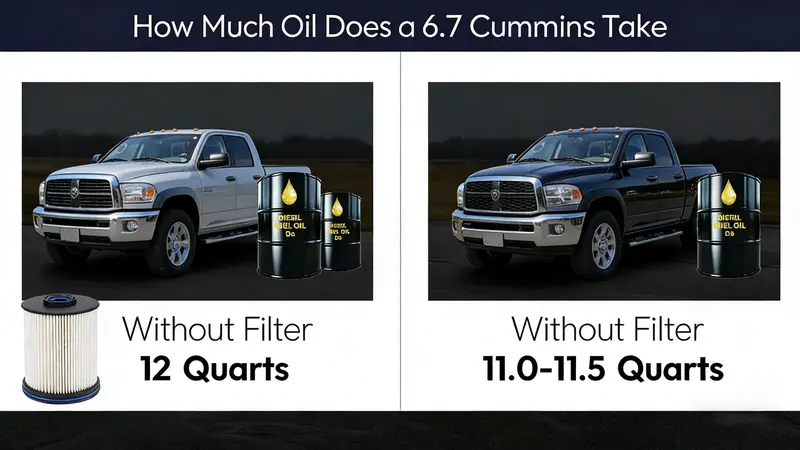
For the 2012 Ram 2500/3500 with the ISB 6.7 engine code, the standard capacity is 12 quarts (about 11.36 liters) with an oil filter change during routine maintenance. Without replacing the filter, it’s around 11 quarts (10.41 liters). This applies across configurations like 2WD/4WD or standard/high-output, as the oil pan and sump design remain consistent. The engine’s deep pan holds extra oil for better cooling under torque-heavy loads (up to 800 lb-ft), a critical feature for its heavy-duty applications.
2018 6.7 Cummins Oil Capacity
The 2018 model, also in Ram 2500/3500, mirrors the 2012 with 12 quarts (11.36 liters) including filter replacement, and 11 quarts (10.41 liters) without. Upgrades like advanced DPF/SCR emissions system for Tier 4 Final emissions didn’t alter the cylinder block or oil pan, so capacity stayed the same. However, the hotter-running emissions system demands higher-quality oil (specifically API CK-4 synthetic oil) to prevent sludge in high-heat scenarios—a key difference from the 2012 model.
2012 vs 2018 6.7 Cummins Oil Capacity Comparison
To make the differences (and similarities) crystal clear, here’s a structured table comparing the two models:
| Category | 2012 6.7 Cummins | 2018 6.7 Cummins | Difference Explanation |
| Oil Capacity (with filter) | 12 quarts (11.36L) | 12 quarts (11.36L) | No difference |
| Oil Capacity (without filter) | 11 quarts (10.41L) | 11 quarts (10.41L) | No difference |
| Core Engine Upgrades | Basic emissions control; no full DPF/SCR | Full Tier 4 Final; standard DPF/SCR | Upgrades did not affect oil pan capacity |
| Recommended Oil Spec | 5W-40 Full Synthetic (API CJ-4) | 5W-40 Full Synthetic (API CK-4) | API grade upgrade to reduce ash and protect DPF/SCR |
Analysis: The lack of capacity change stems from unchanged core architecture—the iron block and deep sump design prioritized durability over emissions tweaks. However, the 2018’s CK-4 spec upgrade is crucial: it reduces ash content to protect DPF/SCR from clogging, especially under heavy loads. Why no difference? Cummins focused on software and aftertreatment, not oil volume, ensuring backward compatibility for fleets that operate both model years.
Supplementary Points
Understanding oil capacity is just the first step—these supplementary details will help you make informed decisions about oil selection, consumption, and filter matching, further protecting your 6.7 Cummins.
6.7 Cummins Recommended Oil Specification
For standard conditions, use 5W-40 full synthetic diesel oil—API CJ-4 diesel oil for 2012 models and API CK-4 synthetic oil for 2018 to match emissions needs. Brands like Shell Rotella T6 or Valvoline Premium Blue work well, as they meet the engine’s high-temperature and high-torque demands.
In special conditions: High-heat (e.g., summer towing in Virginia) calls for 15W-40; low-temps (Virginia winters below -20°C) suggest 0W-40 for easier cold starts and better lubrication during warm-up.
Why Oil Capacity Matters for 6.7 Cummins
Proper oil capacity is non-negotiable for the 6.7 Cummins’ longevity—here’s why: Underfilling leads to poor lubrication, accelerating wear on bearings and turbo—potentially causing $5,000+ failures. Overfilling causes foaming, increasing fuel use and blocking DPF in 2018 models. Proper levels maintain oil pressure (30-80 PSI) for optimal torque delivery, ensuring the engine performs reliably in heavy-duty scenarios. This ties directly to the diesel oil capacity importance for all heavy-duty engines.
Oil Consumption Abnormality: Judgment & Handling
Knowing what constitutes normal oil consumption helps you catch issues early. Normal: ≤0.5 quarts per 1,000 miles. Abnormal: Faster drop with blue smoke or noises—check valve seals, piston rings, or turbo oil seals. Handling: Inspect via compression test; professional fix costs $500-2,000. Forum case: A 2018 owner towed heavy loads, noticed 1 quart/500 miles loss due to turbo seal leak—fixed early to avoid engine damage. For more guidance on oil consumption abnormality, consult a certified Cummins technician.
Maintenance & Care Recommendations
Understanding these supplementary details lays the groundwork for proper maintenance—next, we’ll break down actionable care recommendations tailored to both 2012 and 2018 6.7 Cummins models, focusing on oil-related tasks to maximize longevity.
- Oil Change Cycle: City/highway: every 7,500 miles/6 months; heavy-duty (towing/mining/agriculture): 4,000-5,000 miles/4 months. Heavy-duty use increases oil contamination and heat, requiring more frequent changes.
- Oil Check Method: Cold engine: Pull dipstick, wipe, reinsert fully, check level (between MIN-MAX). Do monthly, or more often if you tow frequently.
- Seasonal Focus: Winter: Switch to 0W-40, check heater to ensure proper oil flow; summer: Inspect cooler to prevent overheating and oil degradation.
- Long-Term Storage: Over 3 months? Change oil before starting to avoid oxidation, which can corrode engine components.
- DIY Replacement Steps: Warm engine to loosen old oil, drain (expect 10-11 quarts). Replace filter (pre-fill with 0.5 quart to avoid dry starts). Add 11 quarts new oil. Run engine 1-2 minutes, wait 15 minutes, top to full on dipstick. Check for leaks after 100 miles. Follow these DIY oil change steps to ensure proper replacement.
Common Misconceptions About 6.7 Cummins Oil Capacity
Even experienced owners fall for these myths—let’s debunk the most common ones to keep your engine protected:
- “The 2018 model has increased oil capacity due to emissions upgrades”—Correct: Capacity unchanged; only specs upgraded for DPF/SCR protection.
- “More oil means better protection”—Correct: Excess causes foaming/DPF issues—stick to 12 quarts with filter.
- “All 6.7 Cummins models have the same oil capacity, regardless of year”—Correct: 2007-2024 models are mostly 12 quarts, but early 2010 variants may be 11—always check your owner’s manual.
- “Regular diesel oil works for the 6.7 Cummins”—Correct: Must be API CJ-4/CK-4 synthetic to avoid emissions system damage and ensure proper lubrication.
- “Oil change intervals can be extended indefinitely”—Correct: Heavy-duty use requires changes every 4,000 miles; ignoring this risks DPF clogging and premature engine wear.
Real case from forums: A 2012 owner overfilled to 13 quarts, causing oil blow-by and $800 in cleanup costs—lesson: Always verify oil level with the dipstick after adding.
Conclusion
In summary, both 2012 and 2018 6.7 Cummins models require 12 quarts of oil with a filter change (unchanged due to stable block/pan design), with the main difference being the need for API CK-4 oil in 2018 models to accommodate upgraded emissions technology. Adhering to these specs, proper change intervals, and regular oil checks is the key to extending your engine’s life to 500,000+ miles—its legendary durability depends on it.
For future trends, as electrification integrates (e.g., hybrid Cummins setups), oil maintenance may evolve with smarter monitoring systems, but the basics—proper capacity, quality oil, and regular care—will remain essential. For more details, explore the links throughout this guide or contact 4BTdiesel for genuine parts and expert maintenance advice.