


The 5.9 Cummins diesel engine is a legendary workhorse, trusted by truck owners, construction professionals, and diesel enthusiasts for its durability and performance. When it comes to maintenance, one of the most critical questions is: how much oil does a 5.9 Cummins take? The answer isn’t one-size-fits-all—oil capacity varies slightly by model year, sub-model, and even whether you’re replacing the oil filter. This guide breaks down the exact oil capacity for every 5.9 Cummins variant, explains how to match capacity with the right oil type, walks you through the oil change process, and debunks common myths. Whether you’re a DIY mechanic or a fleet manager, this is your go-to resource for 5.9 Cummins oil capacity and best maintenance practices.
5.9 Cummins Oil Capacity (1998–2007 Ram Models, Verified & Analyzed)
The 5.9 Cummins was produced in three main sub-models over its lifespan: the 12V 5.9 Cummins (6BT) (1989–1998), the 24V 5.9 Cummins (1998.5–2002), and the ISB 5.9 Cummins (Common Rail) (2003–2007). Each variant has a slightly different oil capacity, especially when accounting for the oil filter (which holds additional oil). Below is a detailed breakdown, organized for quick reference, based on Diesel Hub’s comprehensive 5.9L guide and Hot Shot’s Secret fluid capacities:
| Fluid Type | Application / Variant | Fluid Capacity | Service Interval (Normal / Severe) | Fluid Spec | Notes / Real-World Adjustment | My Take / Pro Tip |
|---|---|---|---|---|---|---|
| Engine Oil | w/Filter (2003–2007, 24-valve ISB) | 12.00 quarts | 15,000 miles/12 mo / 7,500 miles/6 mo | API CJ-4/CK-4, SAE 15W-40 or 5W-40 synthetic | Most owners add 11.5–12.5 quarts; dipstick often shows slightly above full due to drain residue. | The jump to 12 quarts in 2003+ reflects the larger oil filter and emissions-related heat; always pre-fill filter (~1 qt) to avoid dry starts. In Leesburg winters (<0°F), 5W-40 synthetic is essential for flow—many 12v owners stick to 15W-40 year-round but switch in cold. |
| Engine Oil | w/Filter (1989–2002, 12-valve & early 24v) | 11.00–12.00 quarts | 7,500 miles/6 mo / 3,750 miles/6 mo | API CF-4/CG-4/CJ-4, SAE 15W-40 or 5W-40 | 12v often drains ~10–11 quarts; owners add 11.5–12 to reach full mark. | Consensus from CumminsForum and Diesel Hub: 12 quarts is safe and common for all 5.9s—early manuals sometimes said 11, but modern practice is 12 with filter. Don’t chase the “exact” number—dipstick rules. |
| Fuel Tank | 6.25 ft bed | 34.00 gallons | N/A (fill as needed) | Ultra-Low Sulfur Diesel | Real tanks often read 32–33 usable gallons due to sender float. | Fuel additives like Diesel Extreme (every 6,000 miles) and Everyday Diesel Treatment (every fill) are excellent for lubricity and injector health—especially on 2003+ common-rail engines. In winter, switch to anti-gel to prevent gelling. |
| Automatic Transmission Fluid | 48RE (2003–2007) / 47RE (1998.5–2002) | Overhaul: 15.00 quarts Service Fill: 4.00 quarts | 100,000 miles (48RE) / 30,000 miles (47RE) | ATF+4 | Many owners flush 12–14 quarts during service. | Shift Restore additive is a game-changer for aging 47RE/48RE—prevents valve body issues. Interval is optimistic; severe use (towing) = 30,000–50,000 miles for fluid/filter. |
| Brake Fluid | All | N/A (system fill) | Every 2 years or as needed | DOT 3 | Flush every 2–3 years in humid climates. | DOT 3 is fine, but many upgrade to DOT 4 synthetic for better boiling point during heavy towing—Virginia humidity accelerates moisture absorption. |
| Differential Gear Oil | Front (9 1/4″ AA EL / AA / C205F) | 1.70–2.35 quarts | 15,000–30,000 miles (severe); OE undefined normal | SAE 75W-90 synthetic GL-5 | Owners often add ~0.25 qt extra after fill. | Use 75W-90 synthetic (Blue Diamond S9) for better cold flow in Virginia winters; add friction modifier if limited-slip. Severe interval is realistic for towing/off-road. |
| Differential Gear Oil | Rear (10 1/2″ AA EL / 11 1/2″ AA / Model 60 / 9 1/4″) | 2.20–3.80 quarts | Same as front | SAE 75W-90 or 75W-140 synthetic GL-5 | 11 1/2″ AA often needs 3.5–4 quarts total. | 85W-140 in hot/towing conditions (Virginia summers) for extra film strength; 75W-90 is fine otherwise. Check for leaks at seals—common on high-mileage Rams. |
| Engine Coolant | 5.9L Eng | 29.50 quarts (general) 18.7 quarts (2003 noted) | 100,000 miles/5 years (2003–2007) 30,000 miles/24 months (pre-2003) | MOPAR HOAT 5 Year/100,000 Mile or equivalent | Real flush often recovers 18–22 quarts usable; full system ~5–6 gallons. | 2003 note likely refers to engine-only (excluding radiator/heater core); total system is ~29–30 quarts. Use extended-life yellow coolant (Hot Shot’s Secret 150k) for better protection—HOAT is great but flush every 5 years to avoid silicate dropout. |
| Power Steering Fluid | All | Varies (system dependent) | Inspect/replace as needed | ATF+4 | Typically 1–2 quarts total system. | Use MOPAR +4 or Blue Diamond ATF+4—many owners flush every 50,000 miles to prevent pump whine. Capacity varies with cooler/lines; dipstick or level plug check. |
| Transfer Case Fluid | NV271 / NV273 | 4.00 pints (2 quarts) | 120,000 miles | ATF+4 | Simple fill to level plug. | Blue Diamond ATF+4 works well; change earlier (60,000–80,000 miles) if heavy off-road or towing. |
| Windshield Washer Fluid | All | N/A | As needed | Windshield antifreeze | Not radiator antifreeze. | Use premixed winter formula in Virginia—prevents freezing and keeps nozzles clear. |
| Air Conditioning Refrigerant | 5.9L Eng | 1.85 lbs | Recharge as needed | R-134a | Professional recharge recommended. | Common leak at compressor or lines—recharge with PAG oil added. |
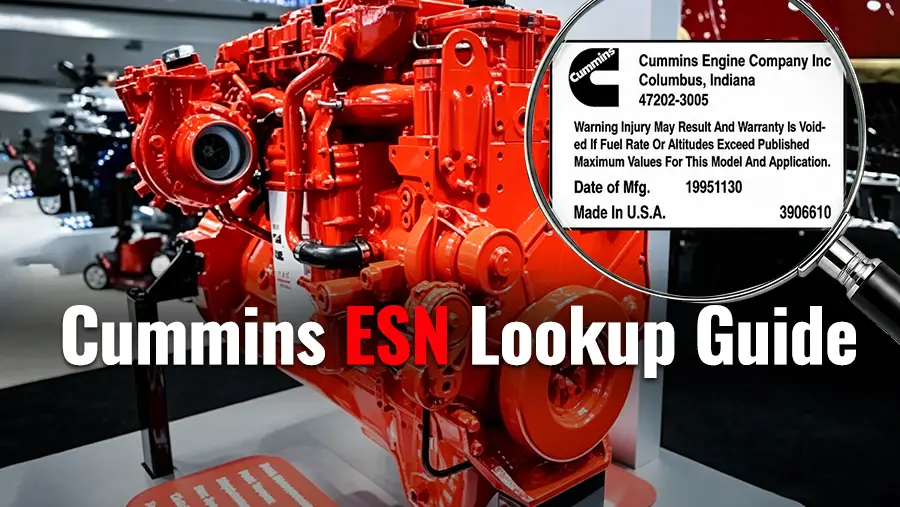
Important: Always check your owner’s manual or Cummins QuickServe Online by entering your Engine Serial Number (ESN) for your specific vehicle’s oil capacity, as rare exceptions (e.g., factory modifications) may apply. The values above represent the most common configurations for 5.9 Cummins engines in Dodge Ram trucks and light commercial vehicles MotorTrend 5.9L history.
Critical Notes: Oil Capacity for Special Configurations
While the above table covers standard 5.9 Cummins engines, some special configurations require adjustments to oil capacity. These include engines used in heavy equipment, modified builds, or those with aftermarket components. Here’s what you need to know, sourced from Diesel Resource 1st Gen maintenance and RV/marine forums:
- Heavy-Duty/Construction Applications: 5.9 Cummins engines used in excavators, generators, or medium-duty trucks (e.g., Freightliner) may have a larger oil pan, increasing capacity to 12–14 quarts (11.4–13.2 liters) with a filter. Always refer to the equipment’s service manual for exact specs Cummins B Series Wikipedia.
- Aftermarket Oil Coolers/Filter Kits: Adding an aftermarket oil cooler or high-capacity oil filter can increase oil capacity by 0.5–1 quart (0.5–0.95 liters). Check the manufacturer’s instructions for the cooler/filter to determine the exact adjustment Fleetguard filter specs via Diesel Hub.
- Modified Engines/RV/Marine: Engines with stroker kits, forged internals, or deep-sump pans (common in RVs) may require 15–19 quarts (e.g., ISB RV models often 16–17 quarts total). Consult your builder or Cummins marine specs for tailored recommendations iRV2 forums discussion.
For 6.7 Cummins oil capacity comparisons (the 5.9’s successor), see our related 6.7 guide.
How Much Oil Does a 5.9L Cummins Take?
For quick access to the core question—how much oil does a 5.9L Cummins take—we’ve simplified the key capacity data here, perfect for users who need a fast answer before diving into details. This section complements the detailed model-year table above, focusing on clarity and accessibility Hot Shot’s Secret quick specs:
- 12V 5.9L Cummins (1989–1998): 12 quarts (11.4 liters) with oil filter; 11 quarts (10.4 liters) without filter.
- 24V 5.9L Cummins (1998.5–2002): 12 quarts (11.4 liters) with oil filter; 11 quarts (10.4 liters) without filter.
- ISB 5.9L Cummins (2003–2007): 12 quarts (11.4 liters) with oil filter; 11 quarts (10.4 liters) without filter.
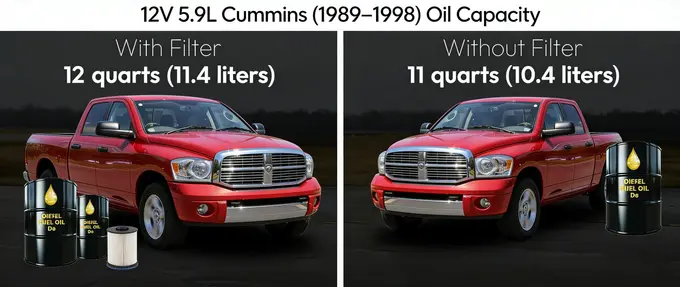
Note: All capacities refer to 5.9L Cummins engines in standard configurations (Dodge Ram 2500/3500, light commercial use). Special applications may vary—always dipstick-verify after filling.
5.9 Cummins Oil Change Intervals
While oil capacity is critical, following the correct oil change intervals is equally important to keep your 5.9 Cummins running smoothly. Intervals vary based on oil type, driving conditions, and engine usage—here’s a detailed breakdown to guide you Diesel Hub maintenance schedules:
- Conventional Oil (API CF-4/CG-4): For light-duty use (highway driving, occasional towing), change oil every 5,000 miles (8,000 km) or 6 months, whichever comes first. For heavy-duty use (frequent towing, off-roading, construction), reduce intervals to 3,000–4,000 miles (4,800–6,400 km).
- Synthetic Oil (API CJ-4/CK-4): Synthetic oil offers better durability and heat resistance, making it ideal for 5.9 Cummins engines—especially ISB models. For light-duty use, change every 7,500–10,000 miles (12,000–16,000 km) or 12 months. For heavy-duty use, change every 5,000–7,500 miles (8,000–12,000 km)Xtreme Diesel 24V guide.
- High-Mileage Oil: For engines with 150,000+ miles, use high-mileage synthetic-blend or full-synthetic oil and change every 5,000–6,000 miles (8,000–9,600 km) to maintain lubrication and reduce leaks.
- Special Notes: If you use your 5.9 Cummins in extreme conditions (extreme cold/hot temperatures like Virginia winters, constant idling, dusty environments), further reduce intervals by 20–30%. Always replace the oil filter with every oil change—never reuse a filter Fleetguard LF16035 specs. Explore our QSK60 engine maintenance guide for larger Cummins comparisons.
Choosing the Best Oil for a 5.9 Cummins
Selecting the right oil for your 5.9 Cummins goes beyond viscosity and API grade—it’s about matching the oil to your engine’s needs and usage. Below is a guide to choosing the best oil, paired with capacity best practices to ensure optimal performance API Motor Oil Guide:
- Oil Viscosity: Match to Climate and Usage Viscosity determines how well oil flows at different temperatures—choose based on your local climate and driving habits Diesel oil recommendations:
- 15W-40: The most versatile option for 5.9 Cummins engines. Ideal for moderate to warm climates (temperatures above 0°F/-18°C) and heavy-duty use. Recommended for most users, including those who tow or use their vehicle for work.
- 5W-40: Best for cold climates (Leesburg, Virginia winters below 0°F/-18°C). Provides better cold-start protection, ensuring oil flows quickly to critical engine components. Suitable for light to moderate use.
- Avoid These Viscosities: 5W-30, 10W-30, or lower viscosities are not recommended—they are too thin for high temperatures and heavy loads, leading to inadequate lubrication even with correct capacity.
- Oil Grade: Comply with Emissions and Engine Requirements
- 12V 5.9 Cummins (1989–1998): API CF-4 or higher. These engines have no advanced emissions systems Cummins B Series specs.
- 24V 5.9 Cummins (1998.5–2002): API CG-4 or higher. Preferred for better protection against wear Diesel Resource 1st Gen guide.
- ISB 5.9 Cummins (2003–2007): API CJ-4 or CK-4 (low-ash). Required to comply with emissions standards (EGR)—low-ash oil prevents clogging API CK-4 details.
- Oil Type: Conventional vs. Synthetic vs. High-Mileage
- Conventional Oil: Affordable for light-duty and older 12V/24V engines.
- Synthetic Oil: Premium for all models, especially high-mileage or heavy-duty—extends intervals Shell Rotella recommendations.
- High-Mileage Oil: For 150,000+ miles, with seal conditioners.
- Recommended Oil Brands for 5.9 Cummins
- Fleetguard (Cummins OEM)—designed for Cummins.
- Mopar (Dodge OEM).
- Shell Rotella T6 (CJ-4/CK-4 synthetic).
- Valvoline Premium Blue.
Pro Tip: Always pair the best oil with the correct capacity—even premium oil won’t protect if under/overfilled. For CCEC QSK60 oil systems, see our industrial engine advantages post.
To reinforce the critical link between oil capacity and oil quality, we’ve summarized key recommendations for each 5.9 Cummins sub-model—aligning directly with the viscosity, grade, and capacity guidelines outlined above:
- 12V 5.9 Cummins (1989–1998): 15W-40 (moderate) or 5W-40 (cold), API CF-4+, 12 quarts with filter.
- 24V 5.9 Cummins (1998.5–2002): Same viscosity, API CG-4+, 12 quarts with filter Xtreme Diesel specs.
- ISB 5.9 Cummins (2003–2007): API CJ-4/CK-4, 12 quarts with filter—critical for larger filter Diesel Power Products.
Step-by-Step: 5.9 Cummins Oil Change Process (Verify Capacity in Operation)
Changing the oil in your 5.9 Cummins is straightforward, but verifying capacity during/after is key Diesel Hub oil change guide:
- Prepare: Warm engine 5–10 min, park level, drain pan under plug.
- Drain Old Oil: Remove plug (25–30 ft-lbs torque), drain ~10–11 quarts Cummins Forum tips.
- New Filter: Oil gasket, hand-tighten +3/4 turn (Fleetguard LF16035/LF3970). Pre-fill ~1 quart Fleetguard specs.
- Refill: Add 90% capacity (e.g., 10.8 quarts for 12-quart spec).
- Circulate: Run 30 sec, wait 2–3 min, dipstick check (MIN-MAX middle). Top off 1/4 quart increments.
- Final: Drive 100 miles, recheck leaks/level.

Common Mistakes About 5.9 Cummins Oil Capacity
Even pros slip up Cummins Forum threads:
- Mistake 1: Assuming uniform capacity—ISB needs 12 quarts vs. 11–12 for 12V/24V.
- Mistake 2: Forgetting filter (~1 quart)—leads to underfill Diesel Truck Resource.
- Mistake 3: Overfill to MAX—causes foaming/seals damage.
- Mistake 4: Wrong oil—pair capacity with CJ-4/CK-4 API Guide.
- Mistake 5: No post-change leak check.
FAQ: Frequently Asked Questions About 5.9 Cummins Oil Capacity
- Q: How much oil does a 12V 5.9 Cummins take with filter? A: 12 quarts—confirmed Diesel Resource.
- Q: 24V 5.9 Cummins oil capacity? A: 12 quarts w/filter Xtreme Diesel.
- Q: Modified 5.9 needs more? A: Yes, +0.5–2 quarts for pans/coolers iRV2 RV threads.
- Q: Dipstick check? A: Post-run, 2–3 min wait, MIN-MAX middle Hot Shot’s Secret.
- Q: 5W-30 OK? A: No—use 15W-40/5W-40 ASE.
Conclusion
The 5.9 Cummins oil capacity is typically 12 quarts with filter across most Dodge Ram configs (1989–2007), with minor variations for 12V/24V (11–12 quarts). Pair with API CF-4+ oils, proper intervals, and dipstick checks for 400,000+ mile life. Avoid pitfalls like overfill—small errors cost big.
For more Cummins maintenance, check 6.7 Cummins oil guide or QSK60 series overview. Shop 4BTdiesel for parts.