

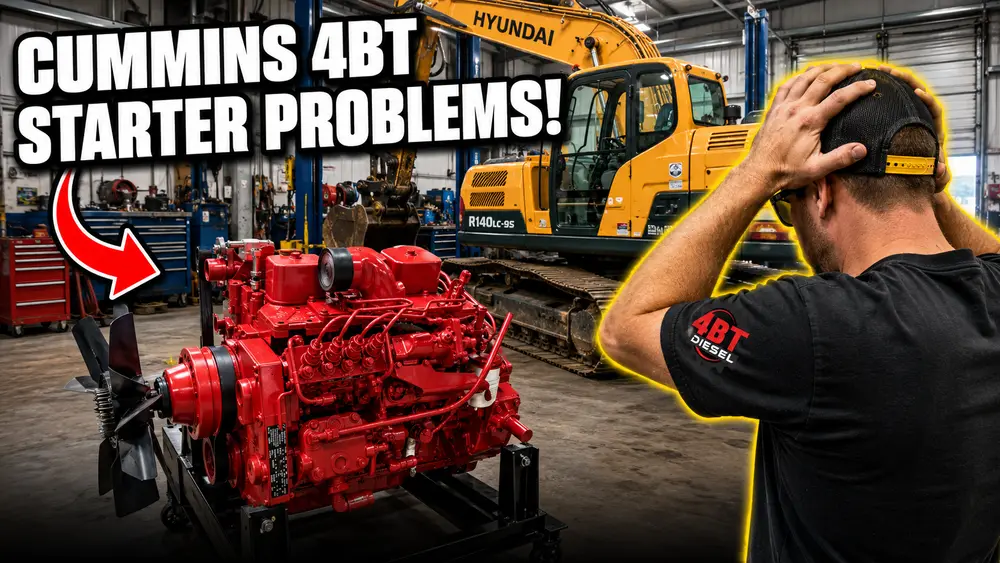
Cummins 4BT starter problems should be diagnosed by what the engine does when you press the start switch. The most important distinction is simple:
- The crankshaft does not turn, or turns too slowly: inspect the battery bank, cables, control circuit, starter and ring gear.
- The crankshaft turns at normal speed but the engine does not fire: the starter is doing its job. Check the fuel shutoff, fuel supply, cold-start system, timing and compression instead.
Do not buy a starter based only on a click or a no-start complaint. A weak battery, corroded engine ground or failed safety interlock can produce the same symptom as a bad starter.
- Confirm whether the crankshaft turns.
- Identify whether the machine uses a 12- or 24-volt starting system.
- Charge and load-test the complete battery bank.
- Measure voltage drop across the positive and negative starter cables while the circuit is loaded.
- Only then test the control circuit, starter and ring gear.
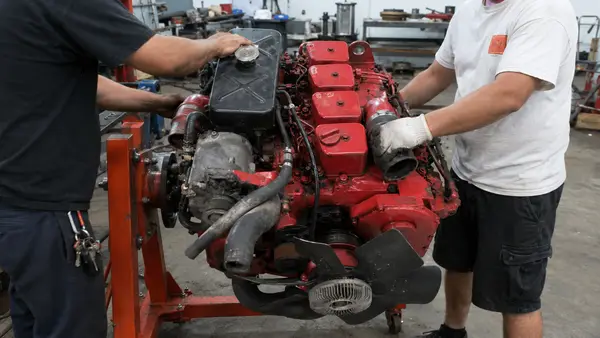
First Decide: What Does the 4BT Do When You Try to Start It?
| Symptom | What It Usually Points To | Check First |
|---|---|---|
| Slow crank | Low battery output, excessive cable resistance, heavy mechanical load or worn starter | Battery load test and main-cable voltage drop |
| Rapid repeated clicks | System voltage collapses when the solenoid engages | Battery bank, terminals and engine ground |
| One solid click, no crank | Main-current problem, solenoid/starter fault or mechanical lock | Battery condition, cable voltage drop and engine rotation |
| No click, no crank | The solenoid is not receiving a usable start command | Fuse, relay, start switch, safety interlock and control wiring |
| Starter whirs but the crankshaft does not turn | Starter drive, pinion or ring-gear fault | Drive engagement and ring-gear teeth |
| Grinding | Incorrect or loose starter, damaged pinion or damaged ring gear | Stop cranking and inspect the mounting and gears |
| Normal cranking but no start | Fuel, cold-start, timing or compression problem | Fuel shutoff position and fuel delivery—not the starter |
This symptom split is consistent with starter-manufacturer diagnostic guidance. Delco Remy separates slow crank, click/no-crank and no-click/no-crank. DENSO also identifies the condition where the starter spins but does not turn the engine.
Before Testing: Confirm Voltage and Make the Machine Safe
A Cummins 4BT may be installed in a truck, generator, boat, skid steer, industrial machine or engine conversion. The engine name does not tell you whether the installed starting system is 12 or 24 volts.
For example, an official Cummins specification sheet for one 4BT3.9-G4 generator-drive engine lists a 12-volt negative-ground system. That does not mean every 4BT uses the same arrangement. Confirm the machine wiring diagram, battery connections and starter tag.
- Two 12-volt batteries connected in series normally supply 24 volts.
- Two 12-volt batteries connected in parallel remain a 12-volt system but provide more available current.
- Never install a 12-volt starter on a 24-volt system or assume the batteries are connected correctly.
Starting circuits carry enough current to cause serious arcing or battery injury. Secure the machine, select neutral or park, disable remote/automatic start and keep test leads away from rotating parts. Cummins advises placing automatic generator controls in Off and disconnecting the negative battery cable before service. Do not bridge starter terminals with a screwdriver as a diagnostic shortcut.
Cummins 4BT Starter Problems: Diagnose by Symptom
The 4BT cranks slowly
Start with the battery bank. A battery can show normal open-circuit voltage but fail when asked to supply cranking current. Charge and load-test the complete bank; if it fails, test the batteries individually.
If the batteries pass, perform positive- and negative-side voltage-drop tests. Also check for the wrong oil viscosity in cold weather, a locked accessory or abnormal engine drag. Only suspect internal starter wear after the batteries, cables and engine load have passed inspection.
Pay attention: a hot cable lug or ground point usually indicates resistance at that location. Do not replace the starter while ignoring a connection that becomes hot during cranking.
There are rapid repeated clicks
Rapid clicking usually means the solenoid pulls in, available voltage collapses, and the solenoid releases. The cycle then repeats. Check the batteries, battery terminals, disconnect switch, positive cable and engine ground before inspecting the starter drive.
There is one click but the engine does not turn
One click shows that at least part of the control circuit is working, but it does not prove that enough current reaches the starter motor. Load-test the battery bank and measure the main-circuit voltage drop.
If power delivery is correct, check whether the engine can rotate using the approved service procedure. A seized engine, locked driven equipment or liquid in a cylinder can prevent a good starter from turning. If the engine rotates normally, inspect the solenoid contacts and starter motor.
There is no click and no crank
Begin on the control side, not by removing the starter. Check:
- Start-system fuse and relay
- Key switch, push button or generator controller
- Neutral-safety, clutch or equipment interlock switch
- Emergency-stop and remote-start circuit
- Control-wire connection at the starter solenoid
- Control-circuit and engine ground
Measure voltage at the solenoid control terminal while the start command is active and compare it with the correct equipment or starter specification. Voltage requirements vary by system and starter design; one generic number should not be applied to every 4BT installation.
The starter spins but the crankshaft does not turn
A fast whirring sound without crankshaft movement usually means the starter drive is not transmitting torque. DENSO lists a faulty overrunning clutch, worn pinion or damaged ring gear as likely causes. Stop repeated attempts and inspect the engagement parts.
The starter grinds
Grinding can damage both the starter pinion and flywheel ring gear. Possible causes include loose mounting bolts, the wrong starter nose or pinion, a damaged drive, incorrect engagement or ring-gear damage. If the starter was recently replaced, compare it physically with the removed unit.
Inspect more than one section of the ring gear when the service procedure allows it. Damage can be concentrated where the engine commonly stops.
The 4BT cranks normally but will not start
This is usually not a starter problem. Once the crankshaft turns at normal speed, check whether the mechanical shutoff lever or electric fuel shutoff solenoid reaches the Run position. Then check fuel supply, air in the fuel system, cold-start aid, injection timing and compression.
Do not keep cranking for long periods to compensate for a fuel-side problem. That overheats the starter and cables without fixing the reason the engine will not fire.
Test the Battery and Cables Under Load
A visual inspection or continuity test can miss resistance hidden inside a cable lug. Voltage drop must be measured while the starting circuit is loaded.
- Positive side: connect the meter between the battery positive post and starter B+ terminal, then load or crank the circuit.
- Negative side: connect the meter between the starter housing/ground stud and battery negative post, then repeat the test.
- Total drop: add the positive and negative readings.
As a general heavy-duty reference, Delco Remy specifies a maximum total loss of 0.5 volt on a 12-volt starter circuit and 1.0 volt on a 24-volt circuit. Use the machine or starter manufacturer’s specification if it differs.
If the reading is too high, separate the circuit into smaller sections until the loss is located. Look for corrosion, loose connections, broken cable strands, an undersized cable or a poor engine-to-battery ground. Repair the cause and repeat the loaded test.
When Is the Cummins 4BT Starter Actually Bad?
Replacing the starter is reasonable when all of the following have been confirmed:
- The battery bank is charged and passes a load test.
- Positive- and negative-side voltage drop are within the applicable limits.
- The control terminal receives the correct start signal.
- The engine and driven equipment are not mechanically locked.
- The ring gear and starter mounting are usable.
- The starter still cranks slowly, fails to rotate or fails its correct bench test.
If a new starter shows the same symptom, return to the test results. The common missed causes are a weak battery under load, corrosion inside a cable, a poor engine ground, a control-circuit voltage loss, damaged ring-gear teeth or an incorrect replacement starter.
How to Match the Correct 4BT Replacement Starter
“Fits Cummins 4BT” is not enough information. Record the following before ordering:
| Information | Why It Matters |
|---|---|
| Original starter manufacturer and part number | Provides the best cross-reference starting point |
| 12- or 24-volt system | Prevents damaging voltage mismatch |
| Mounting pattern and starter nose | Controls fit and pinion position |
| Pinion tooth count and pitch | Must match the flywheel ring gear |
| Rotation and solenoid/terminal position | Affects operation and cable clearance |
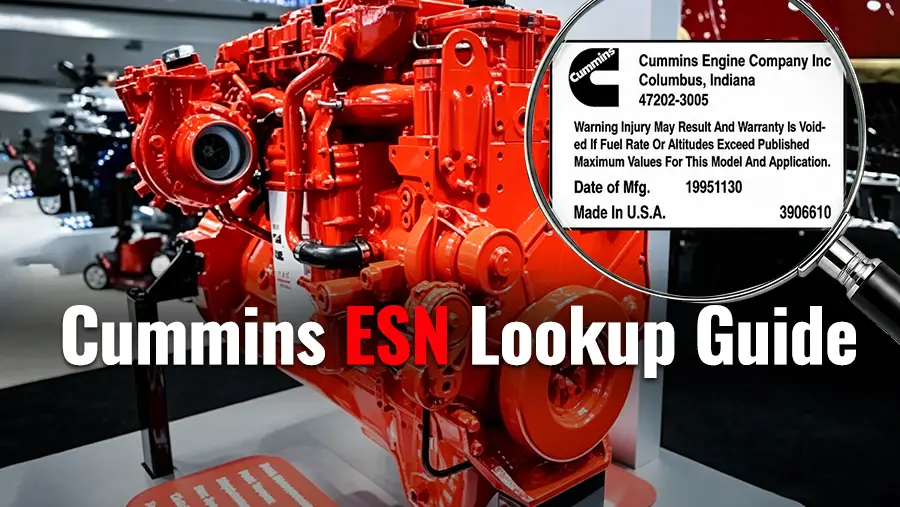
| Engine Serial Number and CPL | Helps identify the original Cummins configuration |
| Machine make, model and serial number | Identifies application-specific wiring and hardware |
Use our Cummins engine serial number guide to locate the ESN and CPL. On an engine conversion, also photograph the installed starter tag, mounting flange, pinion and terminals because the current hardware may differ from the original engine configuration.
4BT Starter Examples by Voltage and Part Number
After recording the original starter details, you can browse the Starter Motor category by voltage, tooth count, replacement number and engine application. The following catalog entries are useful 4BT/B3.9 starting points:
| Catalog Example | Published Specification | Important Application Check |
|---|---|---|
| 12V Bosch-style starter 3901365 | 12V, 10-tooth; listed for Cummins 4BT3.9/4B and 6BT5.9/6B | Match 3901365 or a listed cross-reference and compare the mounting design |
| 12V Delco-style starter 8033340 | 12V, 10-tooth; listed for 4BT3.9/6BT5.9 SkyTrak applications | Use only when the machine model and original starter number also match |
| 24V starter 3934119 / 3957593 / 228000-7902 | 24V, 10-tooth; listed for Cummins B3.9 and specific TUG equipment | Confirm the Denso replacement number and equipment application |
| 24V starter 3935328 | 24V, 10-tooth; listed for Cummins 4B3.9 and specific Hyundai applications | Confirm 3935328 and the installed flywheel-housing arrangement |
For other related engine components, visit the Cummins 4BT parts center. If no catalog example matches the installed unit, send the original starter number, system voltage, tooth count, ESN/CPL and machine information for manual matching.
Sources and Service Information
- Delco Remy: Diagnosing Starter Cranking Problems
- Delco Remy: Checking Voltage Drops
- DENSO: Starter Troubleshooting
- Cummins 4BT3.9-G4 Specification Sheet
- Cummins Engine and Generator Manuals
Technical reference reviewed July 2026. Use the engine, starter and equipment manufacturer’s current safety instructions and application-specific test values.