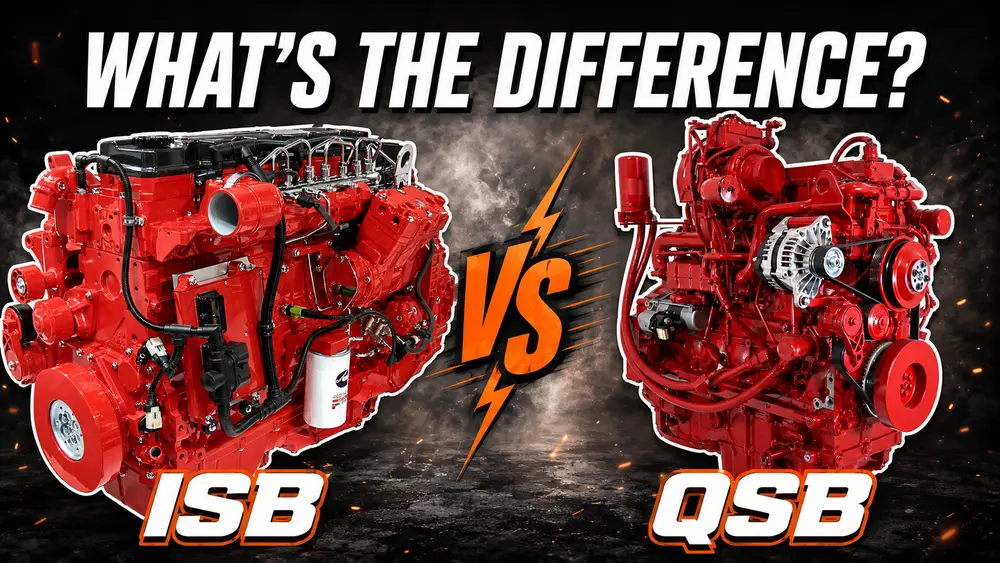
ISB and QSB are related Cummins B-Series engine families, but the name alone does not make their parts interchangeable. ISB is commonly associated with on-highway and vocational vehicle applications, while QSB is commonly used in industrial, construction, agricultural and generator equipment. Before ordering a part, identify the exact displacement, Engine Serial Number (ESN), control system, rating and application.
On-highway and vocational vehicles, including medium-duty trucks, buses, motorhomes and emergency vehicles
Industrial and off-highway equipment, with versions used in construction, agriculture, oil and gas and generator-drive applications
Common examples
ISB5.9, ISB6.7 and market-specific ISBe versions
QSB3.3, QSB4.5, QSB5.9 and QSB6.7, depending on market and emissions generation
What the name tells you
The engine belongs to an electronic B-Series route intended for a defined vehicle and emissions application
The engine belongs to an electronic B-Series route intended for a defined equipment or power-generation application
What the name does not tell you
The exact injector, turbocharger, ECM, fuel pump, sensor, front accessory drive, flywheel housing or current replacement part number
Safe ordering method
Use the ESN and the engine build record, then confirm the current Cummins part number and the removed part’s configuration
Cummins describes the industrial QSB as being based on the B-Series platform. That shared architecture explains why some listings mention both ISB and QSB. It does not prove that every component crosses between applications. The engine family, displacement and physical appearance are starting points; the build record is the deciding evidence.
ISB and QSB Application Names Are Not Part Numbers
Cummins’ official product pages illustrate the application split. The ISB6.7 EPA 2010 page identifies medium-duty truck use and lists a High Pressure Common Rail fuel system. Cummins also lists ISB applications for transit buses, motorhomes, fire and emergency vehicles. By contrast, the official QSB industrial page describes four- and six-cylinder electronic engines for industrial work and lists QSB4.5 and QSB6.7 specifications.
This distinction matters because the equipment manufacturer can specify cooling, mounting, electrical and control arrangements that are different from a truck installation. Two 6.7-liter engines can share major architecture but use different calibration, turbo control, wiring, brackets, oil pans, fan drives or aftertreatment components.
Compare the 4.5L, 5.9L and 6.7L Versions Separately
4.5L Electronic B-Series
The QSB4.5 is an inline four-cylinder engine. Cummins’ industrial QSB specifications list 4.5 liters (275 cubic inches), turbocharging and charge-air cooling. ISBe4.5 and other electronic four-cylinder B-Series names also appear in some regional vehicle markets. Do not select a fuel-system or electronic part only because both descriptions contain “4.5.” Confirm the full model and ESN.
5.9L Electronic B-Series
ISB5.9 and QSB5.9 listings may overlap on base-engine parts, but fuel-system generation and application remain important. An injector or injection pump listing must match the original number, connector, fuel system and engine build. A 5.9-liter description is not enough evidence for an electronic fuel component.
6.7L Electronic B-Series
The 6.7-liter comparison creates the most confusion. Cummins’ QSB industrial page lists the QSB6.7 as an inline six-cylinder 6.7-liter engine. Its ISB6.7 vehicle pages describe ratings and emissions systems for specific on-highway generations. Those official examples confirm the shared displacement, not blanket parts compatibility. Year, emissions level, control-module generation and application can change the correct part.
Parts Most Likely to Differ Between ISB and QSB Applications
Fuel injectors and high-pressure pumps: Match the original or superseding part number, fuel-system generation and connector.
Turbochargers and actuators: Check the turbo model, actuator type, mounting, outlet orientation and calibration requirements.
ECMs, sensors and wiring: A connector that fits does not confirm compatible software, pinout or calibration.
Cooling components: Thermostat temperature, housing, water outlet and equipment cooling package can vary.
Starter motors and alternators: Confirm voltage, tooth count, rotation, flange and electrical terminals.
Oil pans, pickup tubes and accessory drives: Chassis and equipment clearance can determine the configuration.
Aftertreatment components: Emissions generation and application are essential; do not order from displacement alone.
How to Identify the Correct ISB or QSB Engine
Use this order. It prevents a familiar model name or similar photograph from overriding stronger identification evidence.
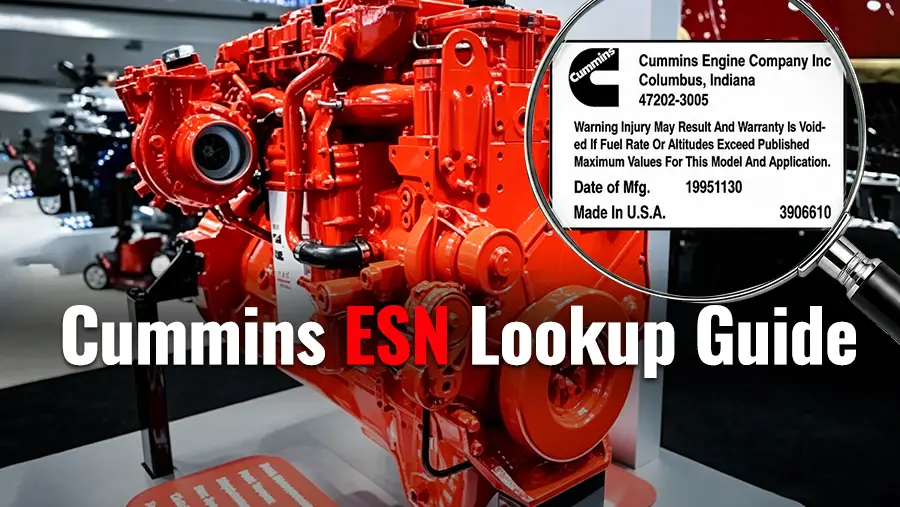
Photograph the complete dataplate. Keep the model, ESN, CPL or configuration information, advertised rating and governed speed visible.
Record the ESN exactly. Cummins’ QuickServe ESN guidance states that Cummins ESNs generally contain eight digits. If the dataplate is missing or unreadable, the number may also be identified on the engine block.
Confirm the application. Record the truck, excavator, loader, generator set, pump or other machine model and serial number.
Read the removed part number. Photograph every label, stamped number and casting number before cleaning or returning the part.
Compare the physical configuration. Check connectors, ports, mounting holes, gear or pulley details, voltage and orientation.
Verify supersessions. Use Parts.Cummins.com or QuickServe Online to confirm the engine build and the current service part number.
Is the CPL Enough to Order Parts?
The CPL is useful, but use it together with the ESN. A CPL helps group a performance configuration, while the ESN identifies the individual engine build. Service replacements and supersessions can also change after production. For electronic fuel, turbocharger and emissions parts, an ESN-based lookup plus the old part number is stronger than the CPL alone.
Example ISB and QSB Parts to Check by ESN
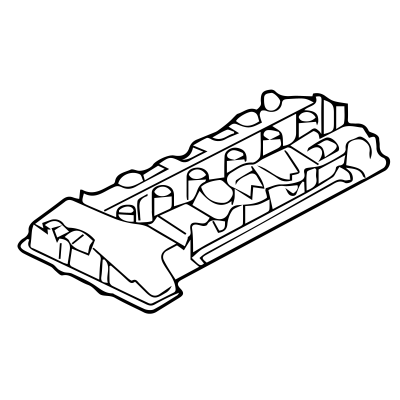
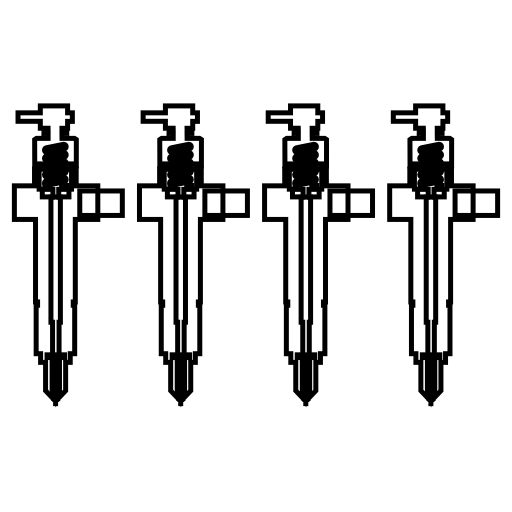
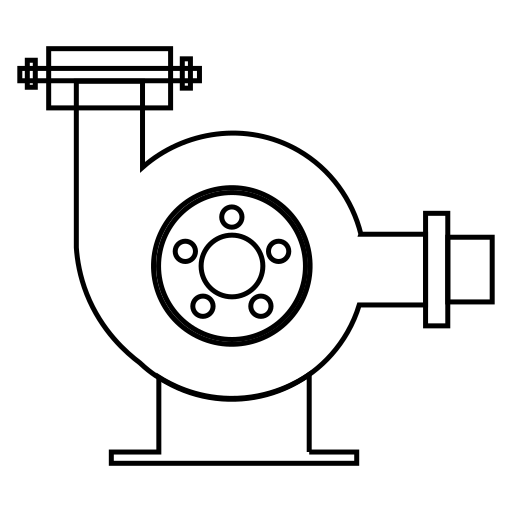
The following listings show why the exact engine and part number matter. They cover different displacements and applications inside the wider electronic B-Series route:
A product title containing both ISB and QSB means that the listing covers stated engine applications. It does not mean the same product fits every ISB or every QSB.
Can You Use QSB Parts on an ISB?
Sometimes, but only when the catalog evidence agrees. Use the part when the Cummins build record or current replacement lookup connects the same part number to both engines and the physical configuration matches. Do not approve interchange from the family name, displacement or appearance alone.
Evidence available
Ordering decision
Only “ISB” or “QSB”
Not enough information
Family plus displacement
Useful for narrowing the catalog, not final confirmation
Model, application and old part number
Good preliminary match; still check current replacement information
ESN-based build record plus verified current part number
Strongest basis for ordering
What to Send for an ISB or QSB Fitment Check
Engine Serial Number and a clear dataplate photo
Full engine model, including displacement and suffixes
Machine or vehicle make, model and serial number
Original part number and photographs from multiple angles
Connector, port, gear, flange or mounting details
Voltage for electrical parts
A description of the repair and failure, especially when several components may be involved
Hi, I’m Kingsley, the author of this post. Has over 10 years of experience in diesel engine parts identification, replacement-part matching, and heavy-equipment parts supply. We provide reliable, high-quality components for construction, mining, agriculture, and heavy equipment applications. If you need durable excavator parts or a free quote, feel free to contact us.
ISB and QSB are related Cummins B-Series engine families, but the name alone does not make their parts interchangeable. ISB is commonly associated with on-highway and vocational vehicle applications, ...
Diagnose Cummins 4BT overheating by pattern. Check the gauge, coolant level, airflow, belt, hoses and cap before testing the thermostat, pump or head gasket.
Diesel engine parts are easier to understand when you stop looking at the engine as one complicated machine and start looking at it as a group of working systems. Air goes in, fuel is injected, compre...
Finding a reliable 4BT diesel engine can feel simple at first. A quick search brings up used engines, rebuilt long blocks, take-out motors, swap packages, and complete running engines. The hard part i...
Compare the Cummins 4BT and 6BT for engine swaps, including size, weight, power potential, fuel economy, towing ability, parts availability, and swap cost factors.