


— From Siberia to the Yukon: A Real-World Troubleshooting Handbook
Introduction: When Steel Freezes in Silence
For those living in temperate climates, 15°F (-10°C) might feel like a harsh winter. But ask the ice road truckers in Yellowknife, Canada, or the transport drivers in Yakutsk, Siberia, and they will tell you: -40°F is the true testing ground for a Cummins engine.
In these extreme conditions, where steel becomes brittle and engine oil turns into molasses, starting a diesel engine is a battle against physics. When you are staring at a truck that is just “blowing white smoke” or suffering from a “slow crank,” anxiety is useless—and firing the “parts cannon” (blindly replacing parts) is an expensive mistake.
In extreme cold, a successful ignition relies on the perfect alignment of the “Iron Triangle”: Sufficient Cranking RPM, Effective Intake Heat, and Proper Fuel Fluidity.
This guide skips the basics. We are diving straight into advanced field diagnostics for Cummins ISB (5.9L/6.7L) and ISX engines, covering Grid Heater load testing, Voltage Drop analysis, and the infamous 6.7L “Killer Bolt.”
Part 1: The Physics of the Cold Start
To troubleshoot effectively, one must first understand why the Cummins engine struggles in the cold. Unlike gasoline engines which rely on a spark plug to ignite the fuel-air mixture, a diesel engine relies entirely on Compression Ignition.
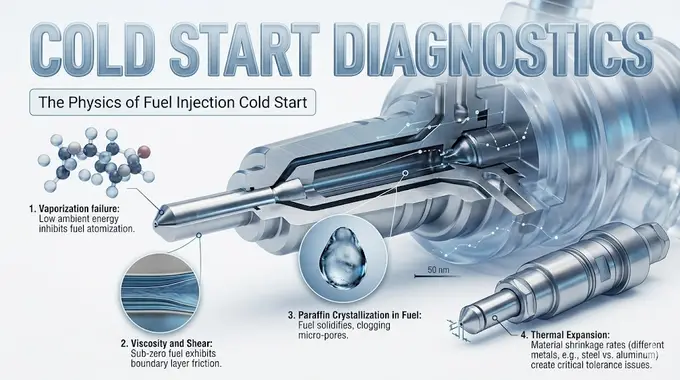
When the piston moves upward, it compresses the air inside the cylinder. This compression generates intense heat—ideally reaching over 400°F (210°C) to auto-ignite the injected diesel fuel. However, in sub-zero temperatures, two physical phenomena work against you:
- The Heat Sink Effect: The engine block, cylinder head, and pistons are massive chunks of cold metal. They act as a heat sink, rapidly absorbing the heat generated by compression before ignition can occur. This is known as “quenching.”
- Viscous Drag: Engine oil at -40°F acts more like tar than a lubricant. This creates immense resistance against the crankshaft, preventing the starter from spinning the engine fast enough to generate the required compression heat.
Therefore, the starting system is not just about turning the engine over; it is about turning it over fast enough while simultaneously adding heat to the intake air.
Part 2: Diagnosing the Intake Grid Heater System
Most mechanics familiar with smaller diesel platforms (like the VW TDI or Ford Powerstroke) instinctively look for glow plugs. Cummins engines, however, utilize a high-amperage Intake Grid Heater.
This system consists of a heating element located in the intake manifold air horn. It draws a massive amount of current (up to 200 Amps) to superheat the air entering the cylinders. If this system fails, the engine will crank and emit raw white smoke (unburned fuel) but will not fire.
The “Voltmeter Drop” Diagnostic Method
You do not need to disassemble the intake or risk frostbite to perform an initial test. The most effective diagnostic tool is already sitting on your dashboard: the voltmeter.
Step 1: Key-ON Engine-OFF (KOEO)
Sit in the driver’s seat and turn the key to the ON position. Do not attempt to crank the engine.
Step 2: Observe the “Wait to Start” Cycle
Watch the voltmeter gauge closely. When the “Wait to Start” light illuminates on the dash, the ECM commands the grid heater relays to close.
- Normal Operation: The voltage needle should drop significantly—often dipping below 11V or even 10V—and hold there for the duration of the cycle (10 to 30 seconds depending on temperature). When the relays click off, the voltage should instantly rebound to 12V+.
- Abnormal Operation: If the voltage needle remains steady at 12V+ while the “Wait to Start” light is on, the system is Open Circuit. The heater element is not drawing a load.
Step 3: Advanced Relay Testing
If the Voltmeter Test failed, you must inspect the solenoids (relays). On 5.9L and 6.7L engines, these are typically located on the driver’s side inner fender or below the battery tray.
- The Click Test: Have an assistant cycle the key while you listen near the relays. You should hear a loud, distinct “click.”
- The Continuity Test: If they click but the grid heater doesn’t work, the internal contacts are likely burnt. Use a multimeter to check for 12V passing through the large terminals of the solenoid when it is activated.
Part 3: Electrical System and Voltage Drop Analysis
In extreme cold, a battery’s chemical efficiency drops by approximately 50%, while the engine’s demand for power doubles to turn the thickened oil. A battery that reads 12.6V (static charge) can still fail miserably under the massive load of a cold start.
This is where Voltage Drop becomes the critical diagnostic factor.
The Myth of the “Bad Starter”
Many starters are replaced unnecessarily because corrosion inside the battery cables adds invisible resistance to the circuit. The voltage is “consumed” by this corrosion before it ever reaches the starter motor.
This is particularly common in the Crossover Cable found in Cummins dual-battery systems.
- The Setup: The primary battery (driver side) connects to the starter. The secondary battery (passenger side) feeds the primary via a long positive crossover cable.
- The Failure: Internal corrosion in this cable prevents the secondary battery from contributing power. Effectively, you are trying to crank a high-compression diesel engine using only one battery.
Field Diagnostics & Specifications
To diagnose this without advanced tools, perform the “Tactile Test“: Attempt to crank the engine for 5–10 seconds, then immediately touch the battery terminals and cable clamps.
Refer to the table below to interpret your findings and verify your battery hardware requirements:
| Component | Condition / Requirement | Diagnosis & Action |
| Crossover Cable | Hot to the touch after cranking. | High Resistance Failure. The heat indicates energy is being lost to internal corrosion. Replace the cable assembly immediately. |
| Crossover Cable | Cool to the touch after cranking. | Normal Operation. The cable is conducting current efficiently without resistance. |
| Battery Specs | Minimum 850 CCA (Cold Cranking Amps). | Requirement. Undersized “marine” batteries will fail in sub-zero temps. Use Group 65 or Group 31. |
| Battery Replacement | One battery is weak/dead. | Replace in Pairs. Never mix old and new batteries. The old battery’s internal resistance will drain and kill the new one. |
Part 4: The 6.7L Cummins “Killer Bolt” Hazard
For owners of 2007.5–2018 Ram 2500/3500 trucks equipped with the 6.7L Cummins, there is a specific mechanical failure point that is exacerbated by winter conditions.
What is the “Killer Bolt”?
The power supply for the grid heater connects to a stud/bolt located on the bottom of the intake horn, directly in the air stream. This bolt is subjected to extreme thermal cycling—heating up to extreme temperatures when current flows, and freezing rapidly when cold air rushes in.
The Failure Mechanism
Over time, the nut securing this bolt vibrates loose. A loose electrical connection creates high resistance, leading to Arcing (electrical sparks). This arcing acts like a plasma cutter, slowly eating away at the metal bolt stem.
Eventually, the bolt snaps. Gravity pulls it down into the intake manifold, where it naturally migrates to cylinder #6 (the rear cylinder).
The Consequence
When the bolt enters the combustion chamber, it collides with the piston. This results in:
- Shattered piston rings.
- Deep scoring of the cylinder wall.
- Bent valves.
- Total Engine Failure requiring a short block replacement.
Inspection and Prevention
We recommend that every 6.7L owner perform a visual inspection of this component, especially during high-mileage service intervals (such as an EGR cleaning or CCV filter change).
- Remove the intake air horn.
- Flip it over and inspect the grid heater assembly.
- Look for Soot: If you see excessive black soot buildup around the electrical connection, arcing is already occurring.
- The Fix: If the bolt is loose or damaged, do not tighten it. The integrity is compromised. Replace the grid heater assembly or install an aftermarket “Grid Heater Delete” or improved intake horn (depending on your climate and emissions regulations).
Part 5: Fuel System Fluidity and Gelling
If your electrical system is robust and your grid heater is cycling, but the engine still won’t start, the issue is likely Fluid Dynamics.
Diesel fuel contains paraffin wax. As the temperature drops, this wax begins to crystallize.
- Cloud Point: The temperature at which small wax crystals appear (fuel looks cloudy).
- Pour Point: The temperature at which the fuel turns into a solid gel.
- CFPP (Cold Filter Plugging Point): The critical temperature where wax crystals become large enough to clog the fuel filter.
The 3-Micron Challenge
Modern High-Pressure Common Rail (HPCR) fuel systems operate at pressures exceeding 25,000 PSI. To protect the sensitive injectors, Cummins specs fuel filters with extremely fine filtration (often 3 to 5 microns).
It does not take a solid block of ice to stop a Cummins; it only takes a thin layer of wax slush to coat the surface of a 3-micron filter. Once this happens, fuel flow stops completely.
Diagnosing Fuel Gelling via Data Stream
Using a diagnostic scan tool (even a basic OBDII monitor), watch the FRP (Fuel Rail Pressure) data PID while cranking.
- Target Pressure: The ECM typically requires a minimum of 4,000 to 5,000 PSI in the rail before it will energize the fuel injectors.
- Diagnostic Logic: If the engine cranks fast (200+ RPM) but the Rail Pressure hovers around 1,000–1,500 PSI, the high-pressure pump is starving. If your lift pump (in-tank or chassis mounted) is humming, the blockage is almost certainly the fuel filter.
The Difference Between Anti-Gel and De-Geller
This is a common mistake made by drivers.
- Anti-Gel (White Bottle): This is a preventative additive. It modifies the shape of wax crystals so they don’t stick together. It must be added before the fuel gets cold.
- Emergency De-Geller (Red Bottle): This contains strong solvents (often alcohol-based) designed to dissolve wax that has already formed. If your truck is galled up on the side of the road, Anti-Gel will do nothing. You need De-Geller and a fresh fuel filter.
Part 6: Fluid Maintenance (Oil & Block Heaters)
Switch to 5W-40 Synthetic:
At -20°F, standard 15W-40 oil creates massive drag on the crankshaft. According to API Motor Oil Standards, switching to 5W-40 Synthetic reduces friction, allowing for faster cranking speeds.
Check Your Block Heater Cord:
If you plug your truck in but the engine is cold, 95% of the time it is a broken Power Cord, not the heater element. Use a multimeter to check the plug for resistance (10-25 Ohms). If it reads “Open,” just replace the cord.
Safety Warning: Do Not Use Ether
We cannot stress this enough: Never use starting fluid (ether) on a Cummins engine equipped with a functional grid heater.
The grid heater element glows red-hot during the start cycle. Spraying highly volatile ether into the intake manifold will result in pre-ignition or a violent explosion inside the intake tract. The force of this explosion can:
- Shatter the plastic intake cover.
- Destroy the MAP/Boost sensor.
- Bend connecting rods due to extreme cylinder pressure spikes.
- Cause personal injury.
If you are in a life-or-death emergency situation and must use a starting aid, you must physically disconnect the trigger wires to the grid heater solenoids to ensure the system is completely disabled before spraying.
Conclusion
Troubleshooting a Cummins engine in extreme cold is not about luck; it is about systematically eliminating variables. The engine is a machine that operates on physics, not magic.
By ensuring your electrical system can deliver high amperage without voltage drop, verifying that the Grid Heater is actively adding heat, and maintaining fuel fluidity with proper filtration and additives, you can ensure reliable starts even in the harshest winters.
Preventative maintenance is always cheaper than a tow truck. Inspect your crossover cables, check that “Killer Bolt,” and keep your filters fresh. For reliable aftermarket replacement parts to keep your rig running—from grid heater relays to block heater cords—explore the catalog at 4BTDiesel.