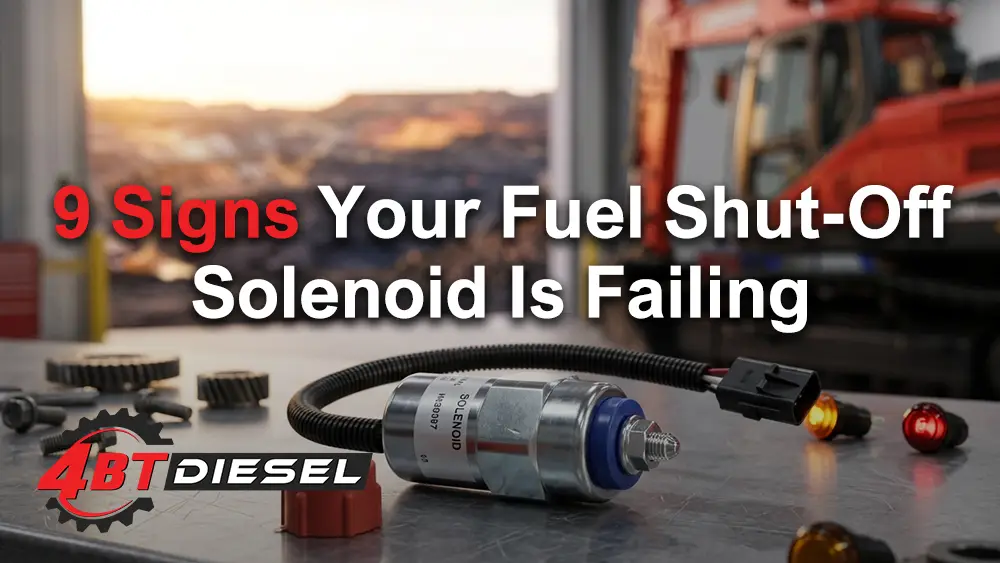
The fuel shut-off solenoid is a small but critical part in diesel engines. It opens to let fuel flow when you start the engine and closes to stop fuel when you turn the key off. This simple action prevents the engine from running on its own (run-on/dieseling) and allows emergency shut-down in dangerous situations.
In heavy-duty trucks, excavators, loaders, and industrial equipment, a faulty fuel shut-off solenoid can cause sudden power loss, hard starting, or even safety risks on the job site. Catching the problem early saves expensive repairs and downtime.
This guide lists the 9 most common symptoms of a bad fuel shut-off solenoid, explains why they happen, and gives clear troubleshooting steps. For high-quality replacement solenoids (especially for excavators and Cummins-powered machines), check 4BTdiesel’s fuel shut-off solenoid collection.
1. Engine Suddenly Shuts Off While Running
The engine loses power and stops without warning — even at idle or light load.
Why it happens: The solenoid fails and cuts fuel supply unexpectedly.
What to do:
Try restarting the fuel pump or resetting any shut-off switch.
Test the solenoid for power (should click when key is turned on/off).
If faulty, replace it. In an emergency you can temporarily bypass it, but replace it as soon as possible — bypassing is not safe for long-term use.
2. Hard Starting or No Start (Especially When Cold)
The engine cranks but won’t fire, or it takes many attempts — worse in cold weather.
Why it happens: The solenoid doesn’t open fully, blocking fuel to the injection pump.
What to do:
Check battery voltage — low voltage can prevent the solenoid from opening.
Listen for the solenoid “click” when turning the key to ON.
Remove and clean the plunger/valve for dirt or sticking.
Replace if the coil is open (test with multimeter) or plunger is stuck.
3. Engine Stalls Randomly at Idle or Light Load
The engine runs fine, then suddenly stalls for no reason — often at idle.
Why it happens: Intermittent solenoid failure briefly cuts fuel flow.
What to do:
Rule out empty tank, clogged fuel filter, or air in lines first.
Check all solenoid wiring for loose, corroded, or broken connections.
Test solenoid resistance (usually 0.5–2 ohms depending on model).
Replace if it fails electrical or mechanical checks.
4. Engine Won’t Shut Off with the Key
The engine keeps running even after you turn the key off (dieseling/run-on).
Why it happens: The solenoid sticks in the open position — fuel keeps flowing.
What to do:
Listen for the solenoid click when turning key off — no click = electrical fault.
Check for stuck plunger or weak return spring.
Inspect wiring and relay for short/open circuit.
Replace the solenoid — this is a safety issue.
5. Rough Idle and Unstable Engine Speed
The engine shakes, RPM fluctuates, or idle is uneven.
Why it happens: Inconsistent fuel delivery due to partial solenoid failure.
What to do:
Test solenoid coil resistance with multimeter.
Check mounting bolts — loose solenoid can vibrate and affect fuel flow.
Inspect fuel lines for air leaks.
Clean or replace solenoid if plunger is dirty or sticking.
6. Weak Acceleration and Loss of Power
The truck feels sluggish, struggles to speed up, or lacks top-end power.
Why it happens: Solenoid doesn’t open fully — not enough fuel under load.
What to do:
Clean solenoid valve/port for carbon or debris buildup.
Check ECM signal to solenoid (should get 12V when running).
Replace if signal is good but solenoid doesn’t respond.
7. Check Engine Light On + Fuel-Related Fault Codes
Dashboard warning light comes on; scanner shows codes like P0215, P0251, P0252, P2665, etc.
Why it happens: ECM detects solenoid circuit open/short or performance issue.
What to do:
Read codes with OBD scanner.
Check solenoid power, ground, and signal wires for corrosion or breaks.
Repair wiring first.
Replace solenoid if circuit is good but code returns.
8. Fuel Leaking Around the Solenoid
Fuel drips or seeps from the solenoid body, connections, or mounting area.
Why it happens: Internal seals or O-rings are damaged or aged.
What to do:
Stop using the engine immediately — fuel leak is a fire hazard.
Inspect seals and valve body.
Replace the entire solenoid (seals alone are hard to source reliably).
Clean area and check for leaks after replacement.
9. Electrical Issues (Blown Fuse, No Voltage, Short Circuit)
Fuse for fuel system blows repeatedly, no voltage at solenoid terminals, or wiring gets hot.
Why it happens: Solenoid coil shorted or open, drawing too much/too little current.
What to do:
Replace blown fuse — if it blows again, there’s a short.
Test voltage at solenoid connector (should be 12V with key ON).
Measure coil resistance (usually 0.5–2 ohms).
Repair wiring or replace solenoid if coil is faulty.
Quick Comparison: Symptoms vs. Likely Causes
Symptom
Most Likely Cause
First Thing to Check
Sudden shutdown
Solenoid cuts fuel unexpectedly
Listen for click; test power
Hard/no start (cold)
Solenoid not opening
Battery voltage, solenoid click
Random stalling at idle
Intermittent solenoid failure
Wiring connections, coil resistance
Engine won’t shut off
Solenoid stuck open
Click sound when key OFF, plunger check
Rough idle / unstable RPM
Inconsistent fuel delivery
Mounting, air leaks, coil test
Weak acceleration
Partial blockage / not opening fully
Clean valve port, ECM signal
Check engine light + codes
Circuit fault or solenoid malfunction
Scan codes, wiring, coil resistance
Fuel leak around solenoid
Damaged internal seals
Stop engine, replace solenoid
Blown fuse / no voltage
Shorted/open coil or wiring
Fuse, voltage test, coil resistance
Fuel Shut-Off Solenoid Quick Maintenance Tips to Prevent Problems
Check solenoid “click” every time you turn the key ON/OFF.
Replace fuel filter on schedule — dirty fuel kills solenoids.
Use high-quality diesel and additives (e.g., lubricity improvers).
Inspect wiring harness yearly for chafing/corrosion.
Clean solenoid plunger if you notice hard starting or stalling.
A failing fuel shut-off solenoid can turn a reliable 5.9 Cummins or other diesel engine into a headache — sudden stalls, hard starts, or run-on can leave you stranded or create safety risks on the job site.
Catching the 9 symptoms early and replacing the solenoid with a quality part saves time, money, and major repairs. For excavators, trucks, loaders, or any Cummins-powered equipment, 4BTdiesel offers high-quality fuel shut-off solenoids, wiring harnesses, and full fuel system components with fast shipping and reliable fitment.
Kingsley
Hi, I’m Kingsley, the author of this post. Has over 10 years of experience in diesel engine parts identification, replacement-part matching, and heavy-equipment parts supply. We provide reliable, high-quality components for construction, mining, agriculture, and heavy equipment applications. If you need durable excavator parts or a free quote, feel free to contact us.
ISB and QSB are related Cummins B-Series engine families, but the name alone does not make their parts interchangeable. ISB is commonly associated with on-highway and vocational vehicle applications, ...
Diagnose Cummins 4BT overheating by pattern. Check the gauge, coolant level, airflow, belt, hoses and cap before testing the thermostat, pump or head gasket.
Diesel engine parts are easier to understand when you stop looking at the engine as one complicated machine and start looking at it as a group of working systems. Air goes in, fuel is injected, compre...
Finding a reliable 4BT diesel engine can feel simple at first. A quick search brings up used engines, rebuilt long blocks, take-out motors, swap packages, and complete running engines. The hard part i...
Compare the Cummins 4BT and 6BT for engine swaps, including size, weight, power potential, fuel economy, towing ability, parts availability, and swap cost factors.